




Intuition for Clinical Reasoning and Self-Care
Have you ever been working with a client and had a feeling or inner knowing that prompted you to ask another question, look more closely, or consider something you had not previously thought about?
As occupational therapists, we draw upon our education, experience, observation, assessment, evidence, and clinical reasoning to understand the people we serve. Intuition can also support this process.
In my book, Intuitive Development: How to Trust Your Inner Knowing for Guidance With Relationships, Health, and Spirituality, I describe intuition as another way of knowing that can work together with our logical and analytical abilities (Vadnais, 2020). Logic is important. Intuition is important. Using both can provide a more complete understanding of ourselves, others, and the situations we encounter.

Intuition and Clinical Reasoning
A recent scoping review published in OTJR: Occupational Therapy Journal of Research examined the role of intuition in occupational therapists’ clinical reasoning (Vermeulen et al., 2025). The researchers reviewed 22 studies and found that intuition has been described as personalized knowledge developed through practice and as a valuable tool in decision-making. The authors suggest that integrating analytical and intuitive processes through reflection can contribute to client-centered expertise.
This reflects what many experienced occupational therapists may recognize in practice. Sometimes we notice something before we can fully explain why it has caught our attention.
An intuitive impression may prompt us to ask another question, observe more closely, consider another possibility, or adjust our approach. We may notice subtle changes in a client’s expression, tone of voice, movement, engagement, or response to an activity that encourage us to explore further.
Intuition may also contribute to creativity and problem-solving—abilities that are especially valuable in occupational therapy, where we continually adapt our approach to the individual person and situation.

Supporting the Whole Person and Function
One of the reasons I was drawn to occupational therapy was its holistic perspective. OT considers the whole person and the many factors that can affect participation in meaningful daily activities and occupations.
Intuitive awareness may contribute to this whole-person understanding.
For example, we may sense that there is more contributing to a person’s difficulty with an activity than what is initially apparent. Further exploration might reveal fatigue, anxiety, fear, motivation, family dynamics, environmental factors, or other concerns.
This information can then become part of our clinical reasoning as we determine how best to support ADLs, occupational performance, participation, independence, and function.

Intuition and Self-Care
Intuition can also support the person providing the care.
Health care professionals can become very good at noticing what other people need while overlooking messages from their own bodies, minds, and emotions.
I experienced this early in my occupational therapy career. Working within fast-paced health care environments, I began experiencing stress and a sense of impending burnout. Something didn’t feel right.
Listening to my intuition eventually guided me to holistic and integrative approaches to health, wellness, and prevention. It led me to a professional path that was more aligned with who I am.
Our intuition may help us recognize when we need rest, support, stronger boundaries, a change in direction, or more of what gives us meaning and joy.
Practices such as meditation and relaxation can support self-care while also creating quiet space to notice our inner knowing. In my own experience, these practices have helped me manage stress, strengthen my intuition, and become more connected with myself.
Developing and Trusting Your Intuition
Intuition isn’t just for occupational therapists or health care professionals. It can support all of us with decision-making, relationships, well-being, personal and spiritual growth, and finding greater meaning and purpose.
One of the challenges is learning to recognize what is intuition and what is not—and developing confidence and trust in what we receive.
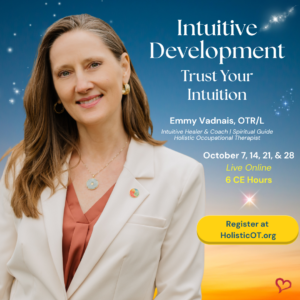
This October, I will be teaching Intuitive Development: Trust Your Intuition, a 4-week live online class designed to help you better understand, develop, and trust your intuition.
October 7, 14, 21 & 28
6:30–8:00 p.m. CDT
Live Online | 6 Hours | CE Available
The class is open to everyone, with 6 continuing education hours available for occupational therapy professionals.
Whether you would like to develop your intuition to support your work, self-care, decision-making, personal growth, or spirituality, I would love to have you join me. ❤️
References
Vermeulen, P., Lavoie, P., Moreau, E., & Rochette, A. (2025). Intuition in occupational therapists’ clinical reasoning: A scoping review. OTJR: Occupational Therapy Journal of Research, 45(4), 640–654. https://doi.org/10.1177/15394492241300604
Vadnais, E. (2020). Intuitive development: How to trust your inner knowing for guidance with relationships, health, and spirituality.
Leave a Reply